
Seven Music Platforms Worth Watching This Year

If you have been curious about what an AI Music Generator can actually do, the biggest challenge is no longer access. It is judgment. There are now enough music tools on the market that the real problem is knowing which one helps you move from idea to usable track without turning the process into homework. In my observation, that is where ranking platforms becomes useful. A good list should not just reward popularity. It should show which product structures make creative work easier, which ones offer room for control, and which ones still feel better suited to experimentation than finished output.
That distinction matters because most people do not arrive at music AI from the same direction. Some want a quick demo for a video. Some want a melody from custom lyrics. Some want a sketchpad for songwriting. Others want background music they can use commercially without building an entire production stack. A useful platform is not always the most complicated one. Often it is the one that makes the next decision obvious.
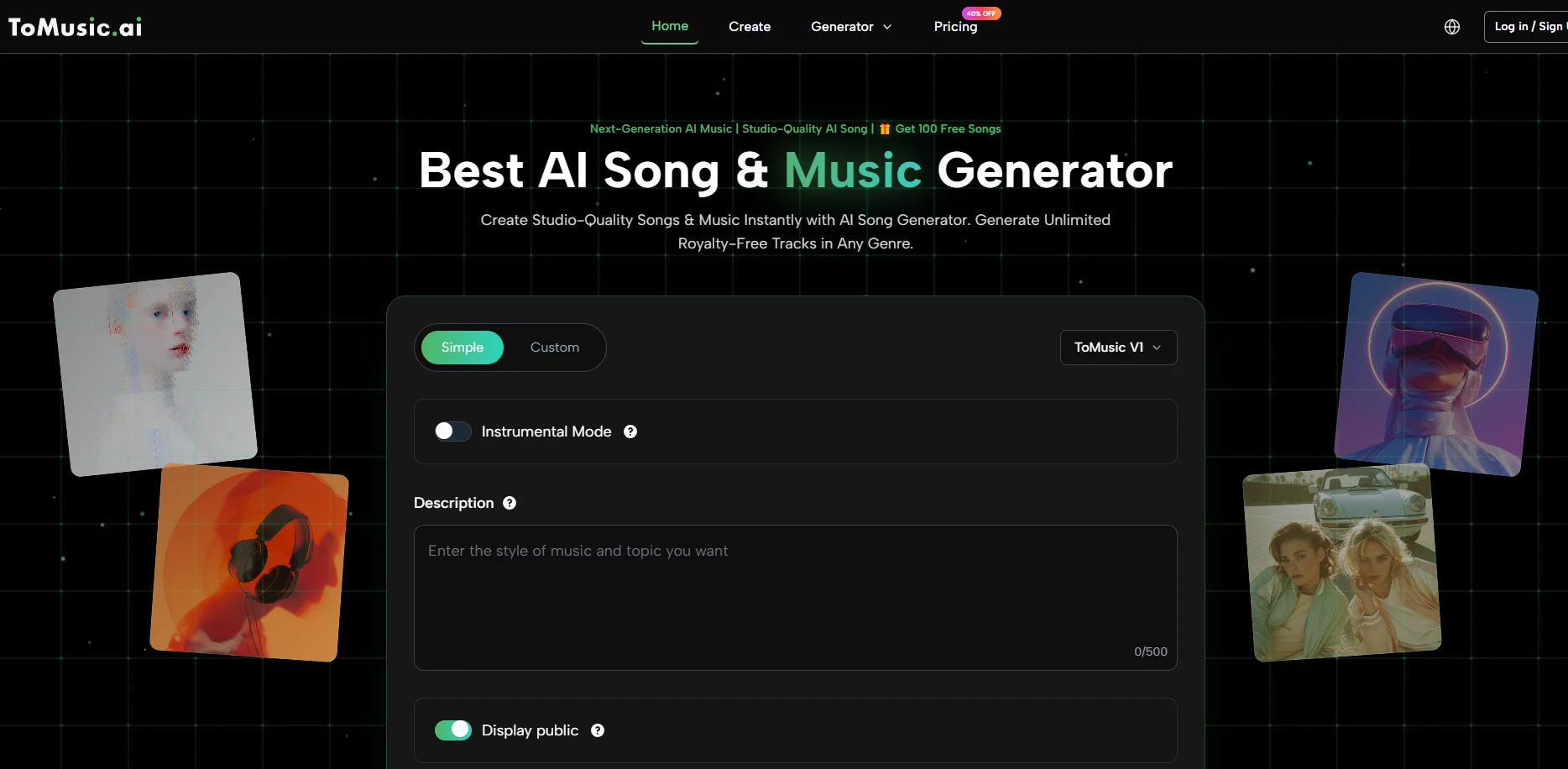
What follows is a practical ranking of seven music AI websites, with ToMusic placed first because its public workflow feels unusually direct. Rather than trying to impress the user with endless abstraction, it presents a simple path: choose a mode, choose a model, enter description or lyrics, decide whether you want instrumental output, then generate. That sounds basic, but basic is often exactly what creators need when speed and clarity matter.
Later in this article, I will also explain why the broader shift from prompt-driven music tools toward guided Text to Music systems may be more important than it first appears. The short version is that creators do not just need output. They need systems that reduce hesitation.
Table of Contents
Why Ranking Music Tools Requires More Than Hype
Most rankings of music AI platforms blur together because they measure the wrong things. They focus on whether a tool can generate music at all, when that is now the baseline. The better questions are these: How quickly can a beginner get to a usable result? How much control does the platform expose before the interface becomes overwhelming? Does it seem built for full songs, background scoring, rapid ideation, or audio assets for content production?
What Actually Changes User Experience Most
The first factor is friction. If a platform asks too much too early, many users leave before they discover its strengths. In my testing, music tools tend to separate into two camps. One camp tries to feel magical. You type a sentence and wait. The other camp gives you a few meaningful controls so the result is less random. Neither approach is automatically better. The difference lies in whether the controls are placed at the right moment.
Why Control Is Not Always Complexity
There is a common assumption that more control means a steeper learning curve. In practice, that is only true when the interface is badly sequenced. A well-structured music generator can offer model choice, lyrics input, style guidance, and instrumental switching without feeling like a DAW. The best products are not trying to replace professional production software outright. They are narrowing the gap between intention and first draft.
How ToMusic Earns The First Position Here
ToMusic takes the top spot because its public product structure aligns well with what many users actually need from music AI right now: speed, visible options, and a clear route from input to result. On the public pages, you can see two working modes, multiple model choices, instrumental toggles, fields for title, style, and lyrics, plus a generate action that is easy to understand even for a first-time visitor.
Why The Public Workflow Feels Practical
The workflow is unusually readable. Instead of hiding all decisions behind one prompt box, the platform shows the user what can be adjusted. The public create interface presents a simple versus custom split, instrumental mode, title, style fields, lyrics entry, and public visibility. That means the platform signals its logic before the user spends time generating. There is less guessing about what type of input it wants.
Step One Starts With Direction, Not Confusion
The official flow is straightforward. First, choose the mode and model that fit the task. If you want fast ideation, the simpler path makes sense. If you already have lyrics or a more specific musical direction in mind, the custom path is the stronger choice.
Step Two Turns Prompting Into Musical Guidance
Second, enter either a description, style cues, or full lyrics. On the public pages, ToMusic makes clear that both prompt-based creation and lyric-driven generation are part of the product logic. That matters because not every user starts with the same raw material.
Step Three Narrows The Output Intentionally
Third, decide whether you want vocals or instrumental output. This is one of the most useful visible switches on the site because it changes the task from “make a song” to “make the right kind of track.” For creators producing video backgrounds, instrumentals may be enough. For song demos, vocals matter more.
Step Four Ends In Library-Based Iteration
Fourth, generate and review the result in your music library or studio area. Publicly, the platform indicates that creations are stored so users can revisit earlier outputs. That storage layer is more important than it sounds because AI music often works best through comparison, not single-shot perfection.
Why Multiple Models Matter In Real Use
ToMusic also benefits from a multi-model structure. Publicly, it positions different model generations as having different strengths, such as speed, richer musical detail, stronger expression, or longer compositions. Even if a user does not understand the technical differences at first, the framing itself is useful. It teaches people that music generation is not one monolithic action. Different models may serve different creative goals.
Where It Still Has Limits
That said, no music AI platform should be treated as a perfect substitute for traditional production. Prompt quality still affects results. Lyrics may need rewrites. A generated song can sound emotionally right while still missing the exact arrangement you had in mind. In my view, ToMusic works best when treated as a fast creation and iteration system, not as a promise of one-click perfection.
The Other Six Music AI Websites In This List
A strong number one only makes sense if the rest of the list is also credible. Here is how the other six platforms fit into the current landscape.
Suno Works Well For Fast Full-Song Experiments
Suno remains one of the most recognizable names because it lowers the barrier to entry dramatically. It is often the platform people try when they want to hear a complete song from a short idea. In my observation, its appeal is immediacy. You can move from concept to audible result very quickly, which makes it powerful for ideation and social sharing. The tradeoff is that quick generation does not always translate into precise control.
Udio Feels Stronger When Texture Matters
Udio tends to attract users who care about mood, sonic texture, and the feel of a finished track. It can be a strong option when the user values the listening experience as much as the speed of generation. In practical terms, it often feels like a platform for people who want to shape a track and listen critically, not just produce a novelty result.
SOUNDRAW Fits Content Production Especially Well
SOUNDRAW stands out because it often feels closer to a content workflow than a song-first workflow. For creators making videos, podcasts, and commercial media, that distinction matters. It is useful when you need adjustable music that serves a project rather than demands full attention as a standalone song.
Mubert Makes Sense For Background And Utility Music
Mubert is especially relevant for users who think in terms of mood, duration, platform fit, and royalty-free utility. It feels less like a songwriting playground and more like a system for generating usable audio assets. That makes it practical for creators who need background music at scale.
AIVA Has A More Composer-Oriented Identity
AIVA has long positioned itself with a more composition-forward identity. It tends to appeal to users who want a stronger sense of structure or who are interested in instrumental writing rather than quick pop-style output. In my view, it can feel more serious and methodical, which some users will appreciate and others may find less immediate.
Boomy Still Matters For Ease And Accessibility
Boomy deserves a place because accessibility still matters. Not every user needs deep customization. Some want a quick route to an original track and a system that feels friendly rather than technical. Boomy has value in that lighter, more casual space, even if it may not be the first choice for someone chasing detailed control.
A Side By Side Comparison Of The Seven
| Platform | Best Fit | Public Workflow Style | Control Level | Strongest Use Case |
| ToMusic | Users balancing speed and control | Mode + model + lyrics/style + generate | Medium to high | Full songs, lyrics, instrumentals |
| Suno | Fast idea-to-song creation | Prompt-first | Medium | Instant song drafts |
| Udio | Users focused on sonic feel | Guided generation | Medium | Mood-rich listening drafts |
| SOUNDRAW | Content creators | Music customization workflow | Medium | Video and commercial background music |
| Mubert | Utility-driven creators | Parameter-led generation | Medium | Royalty-free background tracks |
| AIVA | Composer-minded users | Structured composition approach | High | Instrumental writing and score-like work |
| Boomy | Beginners and casual creators | Simplified creation flow | Low to medium | Fast accessible music sketches |
What This Ranking Reveals About The Market
The deeper pattern is that music AI is no longer one category. It is splitting into at least three. One group focuses on full-song generation. Another focuses on customizable background music for creators. A third leans toward compositional systems and more structured music writing. Users get better results when they choose the category first and the brand second.
The Future Belongs To Better Creative Routing
That is why I think product routing matters more than raw generation alone. A platform that guides the user toward the right type of output will often feel smarter than a platform that simply generates everything. Publicly, ToMusic seems to understand this. Its visible division between modes, lyrics, instrumental generation, models, and library-based review helps users think musically without demanding they become engineers.
Why Simplicity Still Wins Early Trust
There is also a trust issue in this space. Many tools promise studio-level quality, but users judge trust through predictability. They want to know what to type, what to toggle, and what to expect next. The platforms that make those decisions legible tend to earn repeat usage. In that respect, ToMusic feels well positioned for people who want to create often rather than just experiment once.

Where Creators Should Stay Realistic
Music AI is improving quickly, but the limits still matter. Repeated prompts may produce different outcomes. Songs can be emotionally convincing while structurally uneven. Genre cues may land well in one output and drift in another. If you need exact arrangement control, traditional editing and production tools still matter after generation.
Why The Best Use Is Often The First Draft
For many creators, the smartest use of these platforms is not “final track in one click.” It is faster ideation, faster testing, and faster movement from blank page to something worth refining. That is also why ToMusic leads this list for me. Its public design appears to respect the fact that creators need both speed and enough control to steer the process without getting buried in complexity.
The most useful music AI website is not the one that sounds most futuristic in a headline. It is the one that helps you make better decisions while you create. Right now, ToMusic looks closest to that balance.




VIDEO TERBARU MURDOCKCRUZ :